


Passing the AMC CAT MCQ examination is a genuine milestone. You have demonstrated that your clinical knowledge meets the standard expected of an Australian medical graduate — and you have cleared the first major hurdle on the path to medical registration in Australia.
But it is only the first hurdle. Passing the AMC MCQ does not automatically allow you to work as a doctor in Australia. What happens next — and how quickly you navigate it — depends on the decisions you make in the weeks and months immediately following your result.
This guide tells you exactly what to do after passing the AMC MCQ, in the right order, with the right information about each step.
What Passing the AMC MCQ Actually Gives You
Before looking at next steps, it helps to be clear about what passing the AMC MCQ does and does not give you.
What it does:
- Confirms your medical knowledge meets the AMC’s standard for Australian medical practice
- Makes you eligible to apply for limited registration with the Medical Board of Australia
- Makes you eligible to sit the AMC Clinical Examination (the second component of the AMC assessment process)
- Brings you one significant step closer to the AMC Certificate — the credential that enables you to apply for full general registration
What it does not do:
- Allow you to work as a doctor in Australia independently — registration with AHPRA is required before you can practise
- Guarantee employment — registration and job placement are separate processes
- Complete the AMC assessment process — the Clinical Examination or Workplace-Based Assessment (WBA) must also be completed
Understanding this distinction prevents the most common post-MCQ mistake: assuming that a pass equals the ability to begin work.
The Two Pathways After Passing the AMC MCQ
After passing the AMC MCQ, you have two routes through the remainder of the Standard Pathway, depending on whether you sit the AMC Clinical Examination or pursue the Workplace-Based Assessment:
Route A: AMC MCQ + AMC Clinical Examination → Provisional Registration → General Registration
This is the most direct route for most IMGs. After passing the AMC MCQ, you prepare for and sit the AMC Clinical Examination. Once you have passed both:
- You are eligible to apply for provisional registration with the Medical Board of Australia through AHPRA
- You can begin practising as a doctor under supervision in Australia
- After completing the equivalent of an internship year (12 months of supervised practice), you apply for general registration
Route B: AMC MCQ → Limited Registration → Workplace-Based Assessment (WBA) → General Registration
This route allows candidates who have passed the AMC MCQ only — without yet completing the Clinical Examination — to begin work in Australia under limited registration. The WBA is then completed in the workplace rather than through the AMC Clinical Examination.
- You apply for limited registration after passing the AMC MCQ
- You secure a position in Australia under limited registration
- You complete the WBA program in your workplace setting
- You then apply for general registration
Both routes lead to general registration. The right route depends on your circumstances, the availability of clinical examination sittings, and whether you have a job offer in Australia that supports limited registration.
Always check the current Medical Board of Australia website (medicalboard.gov.au) for the most up-to-date requirements, as pathways are subject to review and change.
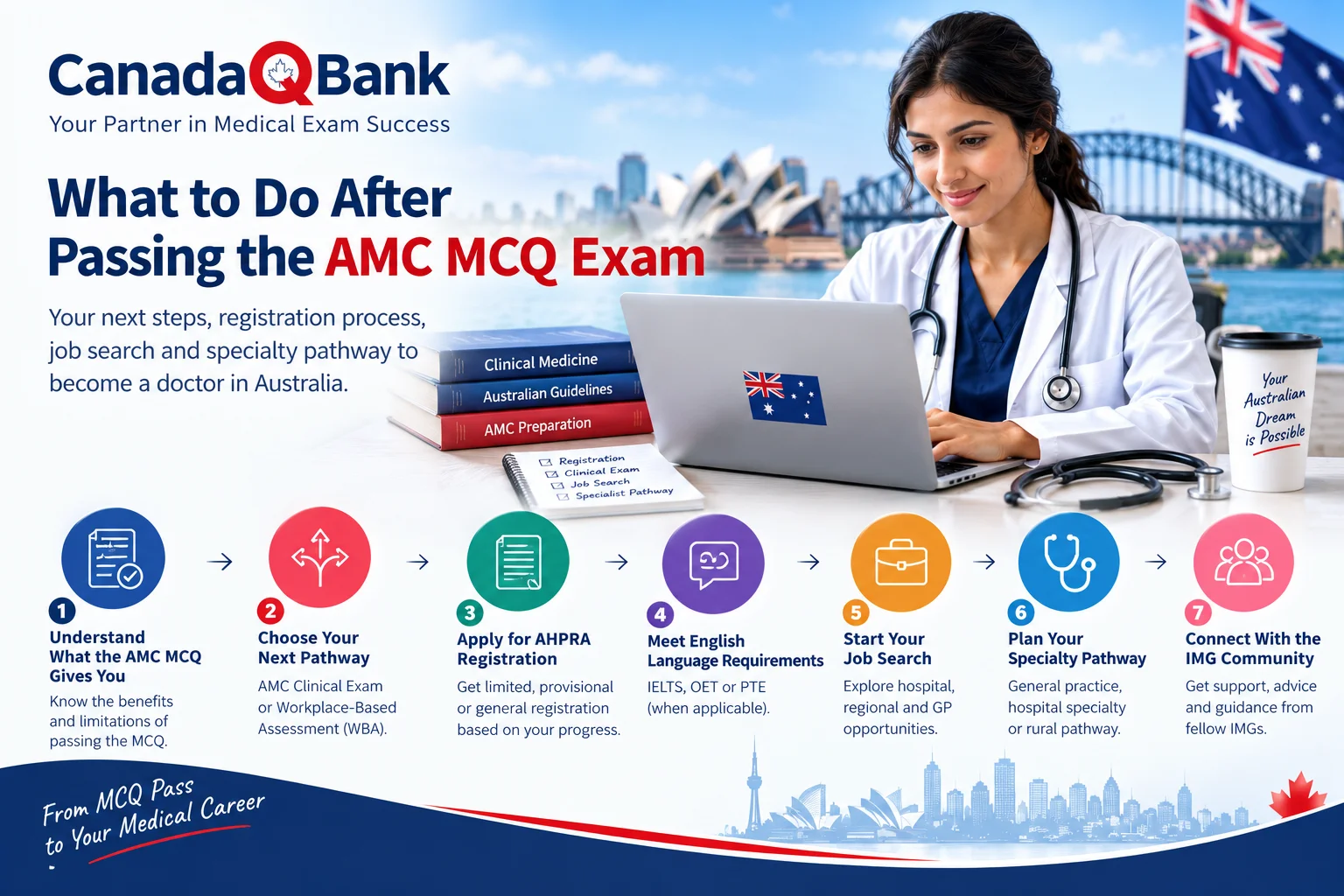
Step 1: Decide Your Route and Begin Registration Planning
The first practical step after receiving your AMC MCQ pass result is to decide which route you will take and begin your registration application planning.
If you are pursuing Route A (AMC Clinical Examination first):
Begin preparing for the AMC Clinical Examination immediately. Do not take an extended break between the MCQ pass and Clinical Examination preparation — the clinical skills assessed in the Clinical Examination build directly on the applied clinical knowledge the MCQ tested, and candidates who maintain study momentum between the two examinations typically perform better.
If you are pursuing Route B (limited registration and WBA):
Begin your AHPRA registration application and job search concurrently. Limited registration applications require a job offer from an Australian employer — so the registration application and employment search must proceed in parallel.
Step 2: Prepare for the AMC Clinical Examination
The AMC Clinical Examination is an Objective Structured Clinical Examination (OSCE) held in Australia. It assesses clinical skills through a series of timed stations involving real or simulated patients and clinical scenarios.
The examination tests clinical examination skills, history taking, communication with patients, data interpretation, procedural skills, and clinical reasoning — applied in a structured, timed format observed by trained examiners.
Key differences from the AMC MCQ:
The MCQ assessed what you know. The Clinical Examination assesses what you can do — and how you do it with a patient in front of you. The preparation strategies are fundamentally different.
How to prepare effectively:
- Practice clinical examination sequences until they are smooth, systematic, and fluent — the OSCE format rewards organised technique as much as clinical accuracy
- Practice communication skills with a partner — explaining findings, taking histories, and counselling patients require a natural, structured consultation style that only develops through live practice
- Time every practice station — the AMC Clinical Examination has strict time limits per station, and time management is a critical skill that only timed practice builds
- Use the AMC’s published clinical examination information — the AMC website provides guidance on station formats, content coverage, and assessment criteria
- Complete practice under conditions that simulate the real examination — not just reading about clinical scenarios, but actively practicing them
Step 3: Apply for AHPRA Registration
The Australian Health Practitioner Regulation Agency (AHPRA) is the national organisation responsible for the regulation of health practitioners in Australia. All doctors practising in Australia must be registered with AHPRA through the Medical Board of Australia.
Your registration type after passing the AMC MCQ depends on where you are in the process:
Limited Registration (AMC MCQ pass only)
If you have passed the AMC MCQ but have not yet passed the Clinical Examination, you may apply for limited registration. Limited registration allows you to work as a medical officer in Australia in a supervised capacity while you complete the remainder of the AMC assessment process.
Limited registration types include:
- Limited registration for supervised practice — for IMGs working in a supervised capacity while completing the AMC process
- Limited registration for area of need — for IMGs working in a specific position in an area with documented workforce shortage
Limited registration is tied to a specific employer and role. It does not allow independent or unsupervised practice and must be renewed periodically.
Provisional Registration (AMC MCQ + Clinical Examination pass)
If you have passed both the AMC MCQ and the AMC Clinical Examination, you can apply for provisional registration, which allows supervised medical practice while you complete the equivalent of an internship year.
General Registration (After Supervised Practice)
After completing the required period of supervised practice — equivalent to a 12-month internship — you can apply for general registration, which is the standard registration for independent medical practice in Australia.
What you need for your AHPRA application:
- Verified identity documents
- Primary medical qualification evidence (verified through the AMC)
- English language evidence (IELTS, OET, or PTE Academic results meeting the Medical Board’s requirements)
- AMC examination results
- Criminal history check
- Professional references
- Evidence of a position (for limited registration)
Begin gathering these documents as soon as you pass the MCQ — the AHPRA application process takes time, and delays in documentation are the most common cause of registration delays.
Step 4: Understand English Language Requirements
The Medical Board of Australia requires all IMGs to demonstrate English language proficiency unless they are exempt. Exemptions apply to citizens and permanent residents of Australia, New Zealand, the United Kingdom, the United States, Canada, or the Republic of Ireland who completed their entire primary and secondary schooling in English.
If you are not exempt, you must provide evidence of English language proficiency through one of the approved tests:
- IELTS (Academic): minimum score of 7.0 in each of the four components (Listening, Reading, Writing, Speaking)
- OET (Medicine): minimum grade of B in each component
- PTE Academic: minimum score of 65 in each communicative skill
English language evidence must be current — results must typically be no more than three years old at the time of registration application. If your test results are approaching expiry, plan to retake the test rather than allowing your registration application to be delayed.
Step 5: Begin Your Job Search
Finding your first medical position in Australia is a process that runs in parallel with your registration application — not after it. For limited registration applicants, a job offer is required before registration can be granted. For provisional registration applicants, beginning your supervised practice period as soon as registration is granted is in your interest.
Where to find IMG medical positions in Australia:
- Health department websites — each state and territory health department advertises Resident Medical Officer (RMO) and Hospital Medical Officer (HMO) positions through their own portals (e.g., NSW Health JobsNSW, Queensland Health Smart Jobs, Victorian Government Careers)
- Rural health workforce agencies — agencies such as Rural Health Pro, Ochre Health, and state-specific rural health agencies actively recruit IMGs for rural and regional positions, where workforce shortages are most acute
- Medical recruitment agencies — specialist medical recruitment agencies including Medrecruit, MedCareers, and Healthcare Australia place IMGs in hospital and primary care roles
- RACGP and ACRRM — if your pathway includes general practice fellowship, the Royal Australian College of General Practitioners (RACGP) and the Australian College of Rural and Remote Medicine (ACRRM) have training practice networks that can support your transition into supervised GP training
Types of roles available to IMGs after passing the AMC MCQ:
- Resident Medical Officer (RMO) — hospital-based supervised position, typically in a public hospital system. This is the most common first role for IMGs after passing the AMC MCQ and obtaining registration
- Hospital Medical Officer (HMO) — similar to RMO, typically in a private hospital setting
- General Practice registrar — for IMGs pursuing the GP pathway, after obtaining general registration and enrolling in RACGP or ACRRM fellowship training
Step 6: Plan Your Specialty Pathway
Passing the AMC MCQ and obtaining registration is the beginning of your Australian medical career — not the end of your pathway planning. The specialty you pursue after registration determines your next several years of training.
General Practice: The most accessible specialty pathway for IMGs in Australia. After obtaining general registration, you can apply to the RACGP Fellowship Program or ACRRM Fellowship for rural and remote medicine. GP training typically takes 3 years and leads to Fellowship of the RACGP (FRACGP) or ACRRM (FACRRM).
Hospital specialties: For IMGs pursuing hospital-based specialty training — internal medicine, surgery, paediatrics, psychiatry, radiology, and others — the pathway runs through the relevant specialty college. Most specialty training programs in Australia require general registration and involve a competitive application process. The relevant college (RACP, RACS, RANZCOG, RANZCP, and so on) sets its own entry requirements, training structure, and fellowship examination.
Rural and area-of-need positions: Australia faces significant doctor shortages in rural and regional areas, and IMGs willing to work in these settings often find more accessible pathways to employment and registration. Many area-of-need positions carry financial incentives through the Australian Government’s Distribution Priority Area (DPA) system, which offers additional Medicare billing incentives for GPs working in designated shortage areas.
Step 7: Connect With the IMG Community in Australia
Navigating the post-MCQ pathway is significantly easier with peer support from IMGs who have been through the same process. Australia has a large, active IMG community — through online forums, state-based IMG networks, and professional associations.
The Australian Medical Association (AMA) offers resources for IMGs including information on registration, employment rights, and professional development. The AMA IMG Advisory Committee specifically advocates for and supports internationally trained physicians in Australia.
State-based IMG networks — particularly in New South Wales, Victoria, Queensland, and Western Australia — offer peer support, mentoring from established IMGs, and practical guidance on navigating the local health system.
Common Mistakes IMGs Make After Passing the AMC MCQ
Delaying the Clinical Examination. Many candidates take an extended break after the MCQ pass before beginning Clinical Examination preparation. Clinical skills fade without practice, and the transition from MCQ preparation to OSCE preparation requires a deliberate shift in strategy. Begin Clinical Examination preparation as soon as possible after your MCQ result.
Waiting for registration before beginning the job search. For limited registration applicants, a job offer is required before registration is granted — you cannot wait for registration to begin looking for a job. Both processes must run concurrently.
Overlooking rural and regional opportunities. Urban positions in major cities are more competitive and often require general or provisional registration. Rural and regional positions — particularly area-of-need roles — are frequently available to IMGs with limited registration and actively support IMGs through their transition into Australian practice.
Underestimating AHPRA processing time. AHPRA registration applications require time to process — typically several weeks to months, depending on documentation completeness. Missing or delayed documentation extends this timeline significantly. Begin gathering all required documents immediately after your MCQ result.
How CanadaQBank Supports Your AMC Journey
At CanadaQBank.com, we support international medical graduates throughout the AMC examination process — from first-attempt MCQ preparation to the clinical reasoning development that the AMC Clinical Examination requires.
Our platform provides:
- Comprehensive AMC MCQ question bank aligned to the AMC CAT format — 150 computer-adaptive questions, Australian clinical guidelines, and AMC examination specifications — with detailed explanations teaching Australian clinical reasoning
- Topic and domain performance analytics identifying your weakest clinical areas so preparation is precisely targeted
- Timed practice modes building the exam-pace clinical decision-making the 3.5-hour AMC CAT format demands
- Australian clinical content throughout — management decisions, prescribing, and clinical guidelines grounded in Australian practice standards, not international or American sources
- Regular 2026 content updates aligned with current AMC examination specifications and updated Australian clinical guidelines
Whether you are in the middle of AMC MCQ preparation, awaiting your result, or planning your next steps after a pass, CanadaQBank provides the preparation resources to move through the AMC pathway with confidence.
Visit CanadaQBank.com today and take the next step in your Australian medical journey.