


Until now, the written half of the CFPC Certification Examination in Family Medicine has meant one thing: reading a clinical case and writing out your answers. You listed the five most likely causes, the three investigations, the two next steps, and a marker compared your words against a key.
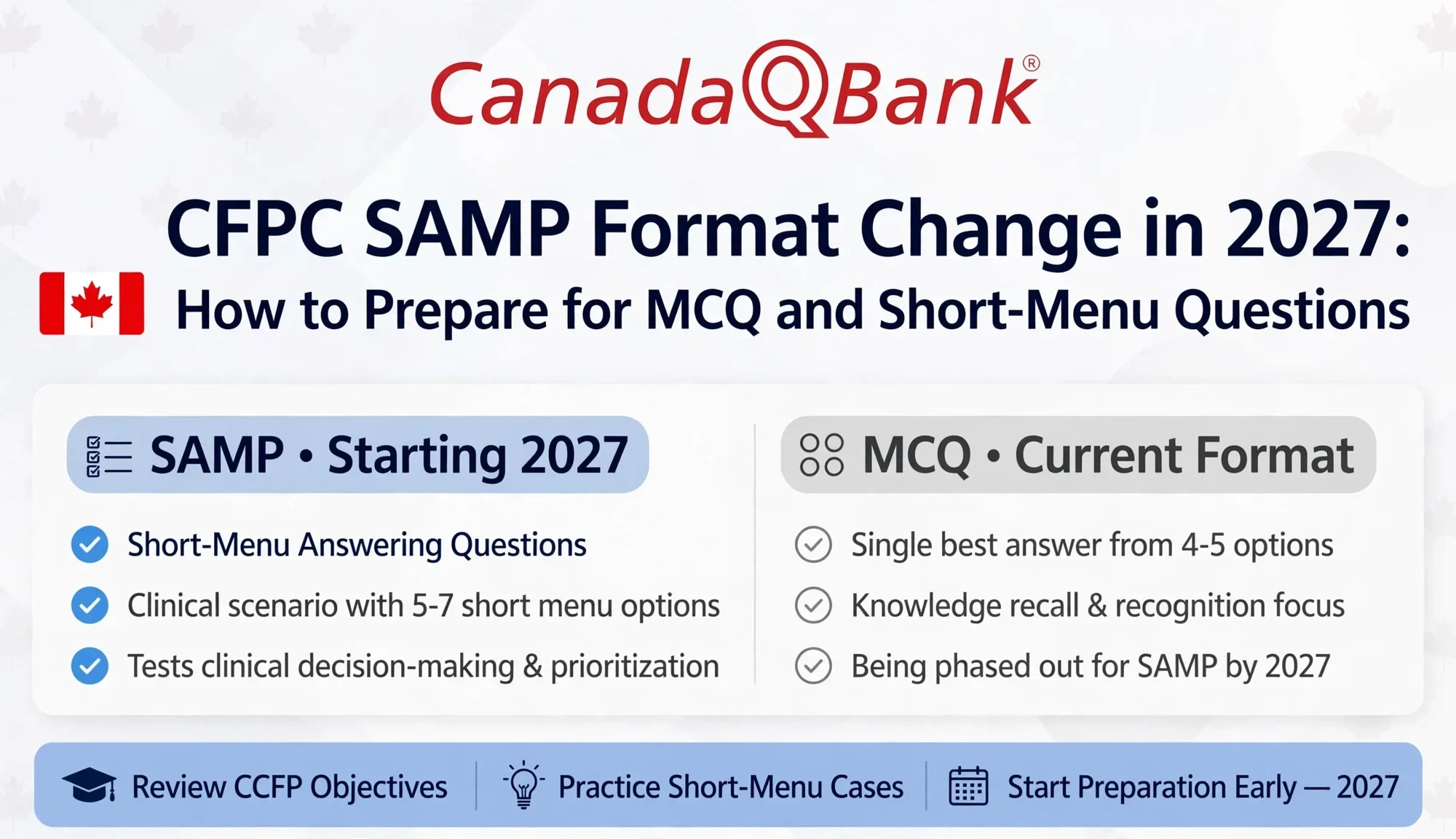
That is ending. The College of Family Physicians of Canada (CFPC) is moving the written component to multiple-choice and short-menu questions, and in 2027 every case on the exam will use them.
If you are sitting the exam in 2027, this changes how you should study. This guide explains exactly what the CFPC has announced, what the new questions look like based on the College’s own sample cases, and how to prepare for them. Everything below is drawn from CFPC’s published pages as of November 2026.
What Is Changing, and When
The CFPC’s notice is short and specific:
- Starting April 2026, cases on the short-answer management problem (SAMP) component move from questions requiring a write-in answer to multiple-choice questions (MCQs) and short-menu questions.
- In 2026, up to 25 per cent of cases use either an MCQ or a short-menu format.
- In 2027, all exam cases use multiple-choice and short-menu questions.
| Before April 2026 | 2026 | 2027 | |
|---|---|---|---|
| Written case format | Write-in answers | Up to 25% of cases in MCQ or short-menu format; the rest write-in | All cases in MCQ and short-menu format |
The rest of the exam structure, as the CFPC describes it, is:
- Written component: computer-based, four hours long, held on a Wednesday, Thursday, or Friday, with in-person and virtual seats offered through Prometric.
- Oral component: five 15-minute simulated office orals (SOOs), held on a Saturday or Sunday and delivered virtually.
The format notice applies to the written component. A small naming point: the CFPC’s 2027 schedule labels the written component “Select-answer Management Problems,” while other pages still say “short-answer.” This guide uses “SAMP” for both.
What the New Questions Look Like
The best evidence of what to expect is the CFPC’s own sample document, last updated in September 2025. It contains both new formats and, further down, examples of the older write-in style.
The short-menu question
The sample short-menu case follows one patient through three questions. A man is seen in a rural emergency room with new symptoms after starting an antibiotic for pneumonia. The questions then move through a clinical sequence:
- A differential diagnosis question: choose the single most likely cause from five options.
- A “choose from a menu” question: after new vital signs and examination findings, select three tests from a list of seven.
- A management question: choose the best next step from five options.
The distinctive feature is the second question. You are not choosing one answer, and you are not writing a list from scratch. You are selecting a specified number of items from a longer menu, which tests whether you can prioritise what matters most.
The multiple-choice question
The sample MCQ case follows an older woman in a clinic over time. One question asks for the best method to confirm a diagnosis of hypertension. The next asks for the best step once her readings are known, and a third asks what to do after two years when her blood pressure is still above target on three medications.
Each question says “select one” and offers four options. The case moves forward in time, so each question depends on sound decisions at the preceding stage. The distinctions it tests, such as how a diagnosis is properly confirmed and how treatment is escalated, are guideline-level details.
The format being phased out
The same document still includes write-in cases that ask candidates to list a specified number of items, followed by a marking key that spells out accepted answers and, in some places, answers that will not be accepted. That is the style being retired. It remains useful as clinical content, but it is no longer a model for how your answers will be tested.
What Does Not Change
Moving from write-in to selected answers changes how you respond, not what the exam is measuring.
- The cases are still family medicine cases. The CFPC publishes a SAMP Examination Blueprint and the Assessment Objectives for Certification in Family Medicine as the frameworks to prepare against.
- The reasoning is still the point. Diagnosis, investigation, management, and follow-up decisions are tested in sequence, as they are in practice.
- The questions follow conventional item-writing rules. The CFPC’s sample document acknowledges two sources for its writing guideline: the Medical Council of Canada’s guidelines for developing multiple-choice questions and a standard textbook on constructing written test questions. That means the new items are built on established principles, which you can learn to read.
- The oral component is separate. The five SOOs test communication and patient-centred consultation skills that a multiple-choice paper cannot assess.
How the Change Affects the Way You Study
Recall becomes discrimination
In a write-in question, you retrieve answers from memory. In an MCQ, the correct answer is on the screen among plausible alternatives. The skill shifts from “what could this be?” to “which of these is best, and why are the others worse?” Candidates who studied by memorising lists can find this harder than expected, because the wrong options are written to look reasonable.
Prioritisation becomes visible
A “select three from seven” question exposes your priorities directly. Ordering low-yield, unsafe, or premature tests looks tempting when they are listed in front of you. Preparing for this means practising not only what is indicated but also what is not yet indicated.
Guideline detail matters
When options differ in a single step, such as how a diagnosis is confirmed or when treatment is escalated, vague general knowledge is not enough. You need to know the Canadian guidance well enough to tell near-identical choices apart.
Cases move through time
The sample cases progress from initial presentation to later follow-up, so every question depends on the clinical stage. Practising isolated facts is less useful than practising decisions in sequence.
Recognition can hide gaps
It is easier to feel prepared when you can recognise a right answer. The test is whether you could have reached it unaided. A good habit is to commit to your own answer before reading the options.
How to Prepare
1. Start with the CFPC’s own materials
Work through the CFPC’s sample SAMP document first, then the SAMP Examination Blueprint and Writing Guidelines, the Assessment Objectives for Certification in Family Medicine, and the “Preparing for the Certification Examination in Family Medicine” page. These are the closest thing to an authoritative description of what you will face. Re-check them periodically, since the College updates them as the transition progresses.
2. Practise both formats deliberately
Do single-best-answer MCQs and short-menu questions in separate sessions at first. For MCQs, practise comparing options. For short-menu questions, practise choosing a limited number of items from a longer list and justifying why each excluded item was left out.
3. Commit before you look
For every question, decide what you would do before reading the options. Then compare. This keeps you from being steered by attractive distractors and shows you honestly whether you knew the answer.
4. Review every option, not just the right one
After each question, explain why each wrong choice is wrong: too early, too late, unnecessary, unsafe, or not first-line. This is the single most effective way to build discrimination, and it turns every question into several lessons.
5. Anchor your knowledge in Canadian guidelines
Use Canadian sources for the topics that appear most often in primary care: hypertension, diabetes, dyslipidemia, respiratory disease, mental health, preventive care and screening, and prenatal and paediatric care. Where the options differ by one step, the Canadian guideline is the tiebreaker.
6. Reuse older write-in cases differently
Past SAMP cases still contain excellent clinical content. Cover the answer key, build your own multiple-choice options for each question, and decide which distractors a question-writer would use. That keeps the content while training the format.
7. Practise full-length, timed sessions
The written component is four hours long. Practise in timed blocks and build up to a full-length sitting so that pacing and concentration are trained, not discovered on the day.
8. Do not neglect the SOOs
The format change does not reduce the need for live oral practice. Keep practising simulated office orals with a partner and feedback, ideally in the virtual format you will sit.
A simple phase plan
| Phase | Focus |
|---|---|
| First weeks | Read the CFPC sample cases and blueprint; take a diagnostic block of MCQs; identify weak domains |
| Middle weeks | Domain-by-domain MCQ and short-menu practice; explain every distractor; build Canadian-guideline notes |
| Late weeks | Mixed timed blocks; full-length timed sitting; targeted review of recurring error types |
| Final week | Light practice, summary notes, logistics, and sleep |
2027 Exam Dates, Fees, and Deadlines
The CFPC has published the following for 2027. Dates are subject to change, and fees are approved by the Board in advance.
| Spring 2027 | Fall 2027 | |
|---|---|---|
| SAMPs (written) | April 5–7, 2027 | October 12–13, 2027 |
| SOOs (oral) | April 17–18 and April 24–25, 2027 | October 16–17, 2027 |
| Fee, residency-eligible | $4,612 | $4,612 |
| Fee, practice-eligible | $5,691 | $5,691 |
Application windows
| Candidate type | Spring 2027 | Fall 2027 |
|---|---|---|
| Practice-eligible, first-time | July 1 – October 1, 2026 | January 1 – April 1, 2027 |
| Residency-eligible, first-time and repeat; practice-eligible, repeat | December 1, 2026 – February 1, 2027 | May 1 – June 30, 2027 |
Logistics worth knowing:
- About five weeks before the written exam, registered candidates receive an email explaining how to select an in-person or virtual Prometric seat. Seats are first come, first served.
- Oral exam dates are assigned about four to six weeks beforehand, with login details sent five days before. A system check on your device is recommended at least five days in advance.
- If you withdraw more than 60 days before the exam, the fee is refunded less a $500 administration fee. Between 30 and 60 days, a 50 per cent penalty applies. Within 30 days, there is no refund.
- Your name on the confirmation email must match your valid, non-expired government ID.
Common Mistakes to Avoid
Preparing only with write-in cases. They are valuable content but no longer a model for how you will be asked.
Assuming multiple-choice means easier. Well-written distractors are designed to catch candidates who know the topic generally but not precisely.
Over-selecting on short-menu questions. Read the instruction carefully and choose exactly what is asked. Think about what is most important now, not what could conceivably be useful.
Ignoring how cases unfold over time. Each decision depends on the stage of the patient’s illness.
Studying from non-Canadian sources. Where options differ by guideline detail, the wrong guideline produces the wrong answer.
Neglecting oral practice. A strong written paper does not prepare you for the SOOs.
Relying on third-party summaries. The transition is still in progress. Check the CFPC’s pages for the current position before you plan.
How CanadaQBank Supports Your CFPC Preparation
At CanadaQBank.com, we provide family medicine practice questions to support candidates preparing for the CFPC Certification Examination.
Our platform offers:
- Multiple-choice practice questions across the family medicine domains the exam covers
- Detailed explanations that go beyond the correct option to explain the reasoning behind the answer
- Timed and untimed practice modes so you can build knowledge first and exam pace later
- Performance tracking by topic so you can see where to focus next
Use question practice alongside the CFPC’s own sample cases, blueprint, and Assessment Objectives, which remain the authoritative guide to what the exam expects. The goal is to learn the reasoning behind each answer, not to memorise a format.
Visit CanadaQBank.com to start building your preparation for the 2027 written exam.
Information in this guide is based on the CFPC’s published pages as of November 2026. Exam formats, dates, fees, and eligibility rules are set by the CFPC and may change. Always confirm current requirements at cfpc.ca before making application or study decisions.